The rest of the pictures are finally posted on Picasa. The trip and the following visit to my hometown wore me down and resulted in a cold. Pictures from the first part of the trip are here. I'll get captions on those pictures soon.
The pictures cover the ride up L'Alpe d'Huez, the balcony road ride and a whirlwind tour of Paris. The Paris pictures include the Viaduct of Arts, Promenade Plantee, Palais de la Porte Doree, Bois de Vincennes, Parc de Belleville, Montmartre & Sacre Couer Basilica and a few from the traditional Siene river sites. I say this after every trip but I really do need to slow down, stop and take more pictures.
Hope you enjoy them!
Tuesday, October 7, 2008


Thursday, October 2, 2008
Velib bikes
With the name ‘Dancing Chain’ it’s time to get back to writing about bicycles. The bicycles in this case are the shared bicycles that took me around Paris for one frantic day of touring.
Paris has a shared and (almost) free bike transit system called Velib for picking up and dropping off bikes throughout the city. There are hundreds of stations throughout Paris with most no more than 300 yards apart. You pickup a bike, ride to your destination and drop it off. When you’re ready to move on, you pick up another bike and go on to your next destination.
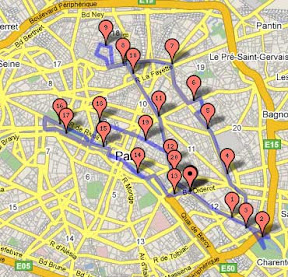
I used Velib bikes to cover over 20 miles in one stupidly ambitious day of sightseeing. Using the Velib bikes is recommended; doing 20 miles in a day isn’t.
My folding bike was available but I chose not to use it. For one thing, it was all packed up and ready for the flight back the next day. And the Velib bikes gave me the freedom to drop off a bike one place, walk around and then just pick up another. With my bike I would have had to lock it and worry about it. And I would have had to return to it. With the Velib system, I simply found the nearest station and grabbed another bike.
How does the system work? For the tourist, you purchase a 1 or 7 day pass at any of the kiosks for about $1.50 or $7.50. The first half-hour of use of a bike is free so $1.50 is all I paid to get around Paris all day. There is an English language option on the terminals although I didn’t notice or use it at first. Sign up was quick and easy. After you agree to the terms and swipe your card, you select a PIN and are then given a print out with an account number. To get a bike, enter the account number and PIN, choose your bike and remove it from the rack. To drop off, just place your bike into a rack and be sure to wait until the blinking light turns green to confirm the return.
For US tourists, an American Express card seems to be the only one that works with the system. Mastercard and Visa do not. I requested an Amex Blue card that has a RFID chip just to try these bikes and had no issues. By swiping the card, the system can charge you if you keep a bike for more than ½ hour as well as hold you responsible if you fail to return the bike ($150).
Having users sign-up makes this bike sharing system different from the free shared bicycle programs tried in various cities (Amsterdam, Portland, Cambridge). Vandalism and theft were issues with such programs. Programs similar to Velib have been started in Washington, Barcelona, Lyon and other cities.
What about the bicycles? These aren’t sub-20 pound racing bikes.
They are sturdy and fat tired with a basket, lights, a little bell and a broad seat. A quick release permits adjustment of the seat height. My guess is they weigh about 50 pounds. You won’t be climbing Alpe d’Huez on one of these. But, if anyone would like to generously fund the attempt, I’d give it go!
They have a grip-shifter with three speeds. The top gear is good for rolling along on the level and used most of the time. The middle gear was about as low as the gearing I used to climb L’Alpe. It was good for getting those 50lbs rolling. I didn’t use the lowest gear that seemed more appropriate for stump pulling. All in all, they were quite practical and well-suited to their purpose.
How was riding in Paris traffic? No problems for me and quite enjoyable. But asking someone who has cycled in Washington, DC rush hour traffic for decades means my answer may not be applicable to you. Certainly, it was better than at home. Within the first two miles of riding on my return to the DC area, someone failed to yield the right of way to me. Nothing similar happened all day in Paris. Oh, and don’t be looking at the sites as you ride.
The on-street accommodations were also better in Paris. When there was a bike lane, it was physically separated from other lanes. This contrasts with the silly, if they weren’t dangerous, painted lines in the DC area that endanger cyclists by putting them next to parked cars and reinforce motorists ignorance of cyclists right to the road. When there wasn’t a bike lane, the bus lane was designated for bicycle use.
All the major traffic circles seemed to have designated bike lanes around them although they tended to put you with pedestrians. Being me, I usually just mixed it up with the traffic at the circles. I wouldn’t recommend that unless you’re experienced and fearless.
Were there any problems? Wear and tear is showing on some bikes, e.g. a broken shifter, soft tire, bent wheel. If the bike had a problem, I stopped at the next station and swapped for another bike. Check out the bike you are going to use before choosing and removing. Calling and reporting problems is the right thing to do but my French was not good enough to so.
While there are many stations, you still should take a map of them with you. If not, you’ll walk or ride around a bit to find one since they aren’t all on the main streets. I didn’t have one and used the map of nearby locations at each station. When leaving a bike to walk around, I’d note the location of nearby stations. On the bike, going from station to station checking the maps got me to where I was going and to a drop-off station. Inefficient but effective.
There was a station kiosk with a display that didn’t work. I could not get a bike although I had returned one there earlier. With lots of stations, I used the map and went to one nearby.
Bike distribution could be an issue although it wasn't for me. One station only had one bike left when I got there. At another, someone who wanted to return a bike had to wait until I came and removed one. I did see a truck moving bikes to a station with very few bikes so they have planned for this.
Overall, it was a great way to get around Paris and see new parts of the city. If you are touring various places in Paris and the weather is nice, give it try instead of the subway. I think you’ll enjoy it.
Paris has a shared and (almost) free bike transit system called Velib for picking up and dropping off bikes throughout the city. There are hundreds of stations throughout Paris with most no more than 300 yards apart. You pickup a bike, ride to your destination and drop it off. When you’re ready to move on, you pick up another bike and go on to your next destination.
I used Velib bikes to cover over 20 miles in one stupidly ambitious day of sightseeing. Using the Velib bikes is recommended; doing 20 miles in a day isn’t.
 |
My folding bike was available but I chose not to use it. For one thing, it was all packed up and ready for the flight back the next day. And the Velib bikes gave me the freedom to drop off a bike one place, walk around and then just pick up another. With my bike I would have had to lock it and worry about it. And I would have had to return to it. With the Velib system, I simply found the nearest station and grabbed another bike.
How does the system work? For the tourist, you purchase a 1 or 7 day pass at any of the kiosks for about $1.50 or $7.50. The first half-hour of use of a bike is free so $1.50 is all I paid to get around Paris all day. There is an English language option on the terminals although I didn’t notice or use it at first. Sign up was quick and easy. After you agree to the terms and swipe your card, you select a PIN and are then given a print out with an account number. To get a bike, enter the account number and PIN, choose your bike and remove it from the rack. To drop off, just place your bike into a rack and be sure to wait until the blinking light turns green to confirm the return.
For US tourists, an American Express card seems to be the only one that works with the system. Mastercard and Visa do not. I requested an Amex Blue card that has a RFID chip just to try these bikes and had no issues. By swiping the card, the system can charge you if you keep a bike for more than ½ hour as well as hold you responsible if you fail to return the bike ($150).
Having users sign-up makes this bike sharing system different from the free shared bicycle programs tried in various cities (Amsterdam, Portland, Cambridge). Vandalism and theft were issues with such programs. Programs similar to Velib have been started in Washington, Barcelona, Lyon and other cities.
What about the bicycles? These aren’t sub-20 pound racing bikes.
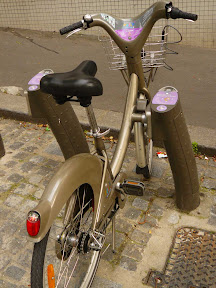 |
They are sturdy and fat tired with a basket, lights, a little bell and a broad seat. A quick release permits adjustment of the seat height. My guess is they weigh about 50 pounds. You won’t be climbing Alpe d’Huez on one of these. But, if anyone would like to generously fund the attempt, I’d give it go!
They have a grip-shifter with three speeds. The top gear is good for rolling along on the level and used most of the time. The middle gear was about as low as the gearing I used to climb L’Alpe. It was good for getting those 50lbs rolling. I didn’t use the lowest gear that seemed more appropriate for stump pulling. All in all, they were quite practical and well-suited to their purpose.
How was riding in Paris traffic? No problems for me and quite enjoyable. But asking someone who has cycled in Washington, DC rush hour traffic for decades means my answer may not be applicable to you. Certainly, it was better than at home. Within the first two miles of riding on my return to the DC area, someone failed to yield the right of way to me. Nothing similar happened all day in Paris. Oh, and don’t be looking at the sites as you ride.
The on-street accommodations were also better in Paris. When there was a bike lane, it was physically separated from other lanes. This contrasts with the silly, if they weren’t dangerous, painted lines in the DC area that endanger cyclists by putting them next to parked cars and reinforce motorists ignorance of cyclists right to the road. When there wasn’t a bike lane, the bus lane was designated for bicycle use.
All the major traffic circles seemed to have designated bike lanes around them although they tended to put you with pedestrians. Being me, I usually just mixed it up with the traffic at the circles. I wouldn’t recommend that unless you’re experienced and fearless.
Were there any problems? Wear and tear is showing on some bikes, e.g. a broken shifter, soft tire, bent wheel. If the bike had a problem, I stopped at the next station and swapped for another bike. Check out the bike you are going to use before choosing and removing. Calling and reporting problems is the right thing to do but my French was not good enough to so.
While there are many stations, you still should take a map of them with you. If not, you’ll walk or ride around a bit to find one since they aren’t all on the main streets. I didn’t have one and used the map of nearby locations at each station. When leaving a bike to walk around, I’d note the location of nearby stations. On the bike, going from station to station checking the maps got me to where I was going and to a drop-off station. Inefficient but effective.
There was a station kiosk with a display that didn’t work. I could not get a bike although I had returned one there earlier. With lots of stations, I used the map and went to one nearby.
Bike distribution could be an issue although it wasn't for me. One station only had one bike left when I got there. At another, someone who wanted to return a bike had to wait until I came and removed one. I did see a truck moving bikes to a station with very few bikes so they have planned for this.
Overall, it was a great way to get around Paris and see new parts of the city. If you are touring various places in Paris and the weather is nice, give it try instead of the subway. I think you’ll enjoy it.
Wednesday, October 1, 2008
French
A potential benefit from this trip was some improvement in my French. In past trips, Deborah has been there, when my basic French skills faltered, to carry on the conversation. She speaks French quite well having spent time as a student in France and French speaking Switzerland. I was looking forward to being forced to survive without her language skills and improve a little. Performing technical support in French, as was to happen, wasn’t on the list of things to master.
Standard things like buying tickets, getting a meal, asking directions and so on went fairly well. There were a few awkward moments as expected. What to me was perfectly clear French was met with uncomprehending looks. But with repetition, gestures and pointing, those moments were easily overcome.
In general, the formality of the French in public, which some mistake for coldness or unfriendliness, works to the tourist’s advantage. The dialogs you learn in the language classes actually work: you greet, they greet and ask what you want, you say what you want, they acknowledge and ask if there is anything else, you say no thank you, they tell you how much, you pay, then you both say good-bye. Works like a charm until there are complications and you don’t know the words and phrases. But still, if you have made the effort in French and don’t bring an attitude, everyone I’ve met has been helpful.
While otherwise very nice, the Ecrins Mountain Lodge was not ideal for learning French as it is run by an English couple. That the other eight guests were from England meant that French language practice wasn’t a lodge activity at all. Although I became more confident in blurting out what seemed to me to be French, my language skills weren’t any better after the first five days in France.
I knew from email correspondence that my B&B host in Paris did not speak English very well. Her English was in fact comparable to my French. This meant that anything other than standard dialogs was going to be a challenge. Imagine then, if you will, the scene as we tried to debug the WiFi connection problems. I made feeble attempts to translate the technical questions I had into French. But her computer knowledge not surprisingly was non-existent. And gestures and pointing aren’t effective ways to communicate technically.
She presented their laptop and I tried to view its configuration. Although I’ve never used Microsoft Vista, let alone in French, I did find my way to the wireless network configuration. But telling her that someone with administrative rights needed to sign in for the configuration to be seen was futile. And so it was every other technical question that was in perfect English in my head. Near I as could tell, my laptop wasn’t getting a DHCP address. She kindly lent me her laptop and while it was working I was able to do the one post and send email to Deborah. But, by the time I left, their laptop’s DHCP address had apparently expired, wasn’t renewed and no connection could be made.
Had my French been better, maybe I could have traded technical consulting work for free lodging. Perhaps that should be my motivation for being more diligent in my French language lessons.
Standard things like buying tickets, getting a meal, asking directions and so on went fairly well. There were a few awkward moments as expected. What to me was perfectly clear French was met with uncomprehending looks. But with repetition, gestures and pointing, those moments were easily overcome.
In general, the formality of the French in public, which some mistake for coldness or unfriendliness, works to the tourist’s advantage. The dialogs you learn in the language classes actually work: you greet, they greet and ask what you want, you say what you want, they acknowledge and ask if there is anything else, you say no thank you, they tell you how much, you pay, then you both say good-bye. Works like a charm until there are complications and you don’t know the words and phrases. But still, if you have made the effort in French and don’t bring an attitude, everyone I’ve met has been helpful.
While otherwise very nice, the Ecrins Mountain Lodge was not ideal for learning French as it is run by an English couple. That the other eight guests were from England meant that French language practice wasn’t a lodge activity at all. Although I became more confident in blurting out what seemed to me to be French, my language skills weren’t any better after the first five days in France.
I knew from email correspondence that my B&B host in Paris did not speak English very well. Her English was in fact comparable to my French. This meant that anything other than standard dialogs was going to be a challenge. Imagine then, if you will, the scene as we tried to debug the WiFi connection problems. I made feeble attempts to translate the technical questions I had into French. But her computer knowledge not surprisingly was non-existent. And gestures and pointing aren’t effective ways to communicate technically.
She presented their laptop and I tried to view its configuration. Although I’ve never used Microsoft Vista, let alone in French, I did find my way to the wireless network configuration. But telling her that someone with administrative rights needed to sign in for the configuration to be seen was futile. And so it was every other technical question that was in perfect English in my head. Near I as could tell, my laptop wasn’t getting a DHCP address. She kindly lent me her laptop and while it was working I was able to do the one post and send email to Deborah. But, by the time I left, their laptop’s DHCP address had apparently expired, wasn’t renewed and no connection could be made.
Had my French been better, maybe I could have traded technical consulting work for free lodging. Perhaps that should be my motivation for being more diligent in my French language lessons.
Tuesday, September 30, 2008
Never fly United
Did I mention that I never intended to fly United airlines to Europe? United has among other things lost my luggage for a week on a flight that I never took. But that is another story.
When searching for tickets for this trip, other airlines took priority and I was pleased when the lowest fare found was with Lufthansa. This was not due to wonderful past experience with Lufthansa. It was just that, having never flown Lufthansa, they have never had the opportunity to provide bad service to me. They still don’t.
Only after purchasing the tickets did it become clear that my flights weren’t just code-shares with United but were, in fact, operated by United. To their credit, the fine United personnel at Dulles managed to overcome the computer system flaws and actually get me into the seat section I had paid for on the trip to Paris. The United staff in Paris not only couldn’t overcome those flaws; they had no particular desire to do so. The check-in agent said there was no other option but said she would ask the gate agent to find a better seat if possible.
The flight was boarding by the time customs and security were cleared. There was just a moment to politely ask the gate agent if she was able to find a better seat while mentioning the mix-up with the upgrade. Much to my surprise she said there were plenty of upgraded seats available if only I had bothered to buy one and began to berate and blame me for the problems. She continued to do so as I walked down the ramp to the plane. Her behavior is still stunning and incomprehensible to me.
And so it was that I spent the return flight in the middle seat in a row of five. I’m not a vindictive man and certainly do not wish the designers and approvers of five-across seating eternal damnation. No, I only wish upon them a lifetime of sitting in that middle seat and with the seat in front fully reclined. Oh, and maybe the strong urge to go to the restroom while trapped there.
There was a short period of small hope. One of the seats next to me appeared to be unoccupied. But then the man sitting on the aisle generously traded seats so that an avoirdupois couple could sit next to each other. And next to me. But I must say in fairness that my four seat mates were good traveling companions as we all endured our cramped spaces. And I must also say that the passengers in the next section, having raised the armrests in the unoccupied seats, were sleeping quite well.
The flight eventually ended with the usual get in a line, wait, then get in the next line and wait. It was good to be home and wonderful to be with Deborah again. There was one piece of unfinished business. As Deborah says, “Don’t these people understand that you’re retired and have the time to act on complaints?” The letter to Glenn Tilton, CEO of United, is already in the mail. There is a tiny chance he’ll provide some United employees with more reasons to dislike him. Effective or not, it always feels good to write and send off an oh-so-polite and reasonable complaint letter. And with the letter sent and this blog posted, it’s now time to move on.
When searching for tickets for this trip, other airlines took priority and I was pleased when the lowest fare found was with Lufthansa. This was not due to wonderful past experience with Lufthansa. It was just that, having never flown Lufthansa, they have never had the opportunity to provide bad service to me. They still don’t.
Only after purchasing the tickets did it become clear that my flights weren’t just code-shares with United but were, in fact, operated by United. To their credit, the fine United personnel at Dulles managed to overcome the computer system flaws and actually get me into the seat section I had paid for on the trip to Paris. The United staff in Paris not only couldn’t overcome those flaws; they had no particular desire to do so. The check-in agent said there was no other option but said she would ask the gate agent to find a better seat if possible.
The flight was boarding by the time customs and security were cleared. There was just a moment to politely ask the gate agent if she was able to find a better seat while mentioning the mix-up with the upgrade. Much to my surprise she said there were plenty of upgraded seats available if only I had bothered to buy one and began to berate and blame me for the problems. She continued to do so as I walked down the ramp to the plane. Her behavior is still stunning and incomprehensible to me.
And so it was that I spent the return flight in the middle seat in a row of five. I’m not a vindictive man and certainly do not wish the designers and approvers of five-across seating eternal damnation. No, I only wish upon them a lifetime of sitting in that middle seat and with the seat in front fully reclined. Oh, and maybe the strong urge to go to the restroom while trapped there.
There was a short period of small hope. One of the seats next to me appeared to be unoccupied. But then the man sitting on the aisle generously traded seats so that an avoirdupois couple could sit next to each other. And next to me. But I must say in fairness that my four seat mates were good traveling companions as we all endured our cramped spaces. And I must also say that the passengers in the next section, having raised the armrests in the unoccupied seats, were sleeping quite well.
The flight eventually ended with the usual get in a line, wait, then get in the next line and wait. It was good to be home and wonderful to be with Deborah again. There was one piece of unfinished business. As Deborah says, “Don’t these people understand that you’re retired and have the time to act on complaints?” The letter to Glenn Tilton, CEO of United, is already in the mail. There is a tiny chance he’ll provide some United employees with more reasons to dislike him. Effective or not, it always feels good to write and send off an oh-so-polite and reasonable complaint letter. And with the letter sent and this blog posted, it’s now time to move on.
Bus? What bus?
There was more drama in last Wednesday's trip to the airport in Paris than desired. An early, leisurely start became a mad dash. Approaching the shuttle bus stop more than five hours before departure, I was pleased to see the Air France shuttle bus already there. Air France runs buses every half hour from the airport to downtown at a price that is more reasonable that a taxi and more comfortable than the RER.
After loading our bags and getting in line, four others and I were told there was no room. We were left with our bags to await the next bus. With buses scheduled every half hour, plenty of time until departure and complete ignorance of the future, this minor set back wasn’t of any concern.
Time passed quickly as we chatted about our trips and made small talk. More and more people gathered for the next bus. Soon over an hour had passed and no other buses had come. We took some comfort in seeing that several flight attendants were waiting with us and that they seemed unconcerned. But an hour became an hour and a half and then two. The flight attendants abandoned the line and flagged down a taxi. For those of us paying attention, this was our signal to panic.
First, two of my four original companions flagged down a taxi. Then the two others did and kindly invited me to join them. With the trunk of the taxi filled, my large bike case took the front seat, and the three of us squeezed uncomfortably into the back seat with along with a few remaining small bags. There was now less than two hours until take-off and at least a forty minute ride to the airport. As the taxi alternately raced along and sat in traffic jams, two thoughts were on my mind: Was I going to make my flight? And, having failed to ask before jumping into the taxi, how much was this going to cost me?
While pondering these, I learned that the couple were Chinese living in Finland; that they had gone to Lourdes to pray for the wife’s health; that the taxi driver was from Vietnam with a brother in Houston and many other fascinating tidbits. They were nice people and interesting to talk with. Uncomfortably pressed against the door with luggage in my lap and concerned about making the flight I confess my mind wasn’t really on the conversation.
With no idea what time it was, we arrived at the terminal and the answer to the first question was provided: $64. Unless you add the cost of the unused bus return ticket that makes it $18 more. In keeping with the spirit of the day, the taxi dropped me off as far as possible from the United counters. The long line of passengers awaiting my flight was eventually found after a mad dash. With less than an hour until take-off, it was comforting to know many others were just as late.
But comfort wasn’t part of this day’s theme. As we’ll see in the next post, with no knowledge of the future, how could I know that the taxi ride had simply been practice for the rest of my journey?
After loading our bags and getting in line, four others and I were told there was no room. We were left with our bags to await the next bus. With buses scheduled every half hour, plenty of time until departure and complete ignorance of the future, this minor set back wasn’t of any concern.
Time passed quickly as we chatted about our trips and made small talk. More and more people gathered for the next bus. Soon over an hour had passed and no other buses had come. We took some comfort in seeing that several flight attendants were waiting with us and that they seemed unconcerned. But an hour became an hour and a half and then two. The flight attendants abandoned the line and flagged down a taxi. For those of us paying attention, this was our signal to panic.
First, two of my four original companions flagged down a taxi. Then the two others did and kindly invited me to join them. With the trunk of the taxi filled, my large bike case took the front seat, and the three of us squeezed uncomfortably into the back seat with along with a few remaining small bags. There was now less than two hours until take-off and at least a forty minute ride to the airport. As the taxi alternately raced along and sat in traffic jams, two thoughts were on my mind: Was I going to make my flight? And, having failed to ask before jumping into the taxi, how much was this going to cost me?
While pondering these, I learned that the couple were Chinese living in Finland; that they had gone to Lourdes to pray for the wife’s health; that the taxi driver was from Vietnam with a brother in Houston and many other fascinating tidbits. They were nice people and interesting to talk with. Uncomfortably pressed against the door with luggage in my lap and concerned about making the flight I confess my mind wasn’t really on the conversation.
With no idea what time it was, we arrived at the terminal and the answer to the first question was provided: $64. Unless you add the cost of the unused bus return ticket that makes it $18 more. In keeping with the spirit of the day, the taxi dropped me off as far as possible from the United counters. The long line of passengers awaiting my flight was eventually found after a mad dash. With less than an hour until take-off, it was comforting to know many others were just as late.
But comfort wasn’t part of this day’s theme. As we’ll see in the next post, with no knowledge of the future, how could I know that the taxi ride had simply been practice for the rest of my journey?
Catching up
The Internet connections problems in Paris interrupted posting there. Then on my return I immediately left to visit my aging parents and see my somewhat less aging high school classmates. So over the next few days, I'll be wrapping up the account of this adventure with additional posts.
Tuesday, September 23, 2008
Last Post from Paris
It has been a very busy day with lots of walking and biking. I really tried to do too much and should have just stayed in one area. I spend most of the day biking from one place to another on the Velib bikes which can be picked up and dropped off all over the city.
Briefly, I went to Port Doree to see the bas-relief on the Palais du Port Doree, then past Pere-Lachaise to the Parc de Belleville which has a overview of Paris (unfortunately, it was cloudy). Next was the Canal St. Martin with shops and cafes beside an old canal. Then it was off to Montmartre to see the church there. It was an absolute madhouse of tourists and touts. By then I was running late for the walking tour at 3 and had just a few minutes back at the B&B to freshen up and pickup some camera supplies. It was back on the bike to the Ile St. Louis to meet the World War 2 walking tour with minutes to spare. The walking tour was disappointing as it was mostly walking from Notre Dame to the Arc du Triomphe will a few stops for talking. Then it took me a long walk to find another Velib bike and then a long ride back home.
So I'm beat and plan to nap and then get an early dinner. I am really ready to be home.
Pictures and a few more tour descriptions will have to wait until I am home. Oh, did I mention that it is off to my 40th high school reunion two days after returning from France?
Thanks again for reading.
Briefly, I went to Port Doree to see the bas-relief on the Palais du Port Doree, then past Pere-Lachaise to the Parc de Belleville which has a overview of Paris (unfortunately, it was cloudy). Next was the Canal St. Martin with shops and cafes beside an old canal. Then it was off to Montmartre to see the church there. It was an absolute madhouse of tourists and touts. By then I was running late for the walking tour at 3 and had just a few minutes back at the B&B to freshen up and pickup some camera supplies. It was back on the bike to the Ile St. Louis to meet the World War 2 walking tour with minutes to spare. The walking tour was disappointing as it was mostly walking from Notre Dame to the Arc du Triomphe will a few stops for talking. Then it took me a long walk to find another Velib bike and then a long ride back home.
So I'm beat and plan to nap and then get an early dinner. I am really ready to be home.
Pictures and a few more tour descriptions will have to wait until I am home. Oh, did I mention that it is off to my 40th high school reunion two days after returning from France?
Thanks again for reading.
Subscribe to:
Posts (Atom)

 Posts
Posts


